|
1) Nancy, his eighteen year old daughter, met and married an idler, a handsome member of the European titled set, a "count" whose only known interests were partying, womanizing, and yachting. Harry's daughter could not have picked a man more dissimilar to her father, who was the ultimate "rough and ready" self-made man. Needless to say, her father and her husband despised each other, as evidenced by loud public rows.In 1943, Harry was found murdered, beaten to death, his body burned to a crisp. Killed by the mob? Killed by his son-in-law? Nobody knew. Harry's son-in-law was arrested and tried, but even Harry's daughter, who knew him better than anyone, thought him incapable of such an action. The evidence against him was circumstantial, the investigation was bungled (some say deliberately, to cover up mob involvement), and the count was ultimately set free. Court TV did an elaborate and detailed report on the background behind the Oakes trial, but they could reach no definitive conclusion and the murder remains unsolved to this day. What a story for a movie! Right? Although the script changed everyone's names (would you want Lucky Luciano's friends mad at you?), the story was clearly Harry's, almost down to the last detail. The cinematography was stunning, The casting was perfect. Gene Hackman played crusty old Harry Oakes, and the parts of his spoiled daughter and her handsome, amoral count were played by Theresa Russell and Rutger Hauer. Joe Pesci played Meyer Lansky, and Mickey Rourke played the soft-spoken but lethal Lucky Luciano. In concept, it seemed like a no-brainer that should have proceeded directly to the Oscar Night stage. I know what you must be thinking: "With a great story like this, magnificent cinematography, and a perfect cast, why have I never heard of this movie, and why is it rated a mediocre 6.0 at IMDb?" For you experts, the answer is "Nick Roeg." For the rest of you, the short answer is "because it isn't that good," but those words will just prompt you to ask "why?" The first problem is that the stories of Harry Oakes and Nancy Oakes are not one story, but two separate stories that intersected only briefly, when Nancy's husband was accused of killing Harry. Since the count was exonerated, that fleeting intersection was of minimal importance. By combining the two stories into one, the screenwriter and director painted themselves into a cinematic corner. They were painting a portrait of Harry Oakes, absorbing the audience into his Citizen Kane existence, when Harry was suddenly dead, and the movie still had a lot of running time left. Harry's death just drained all the energy from the film. The second problem? Well, this great story called for a no-bullshit director who could tell the story in an interesting way. I think Clint Eastwood would have been perfect, inasmuch as he was extraordinarily successful with a similarly long and rambling story in The Outlaw Josey Wales. Instead of Clint, we got artsy-fartsy Nick Roeg, a confused story teller with no good sense of a strong campfire tale. Roeg was a classic example of the Peter Principle, a brilliant cinematographer who worked his way up to a directing job, and settled in there, at his level of incompetence. His images were visual poetry, but in the natural interaction of people and the simple logic of storytelling, Roeg was overmatched. Pretentious dialogue compounded the problem. The characters kept trying to intellectualize with philosophical musings and long speeches, all of which served to try to reveal points which were already evident (or should have been) in the plot and visuals. Gene Hackman was the only actor in the film who truly had the gift to breathe life into the rhetorical dialogue and make it sound like human speech instead of human speeches. Once Hackman was gone, the damned movie seemed like one of those hollow European art films where people deliver sonorous speeches while looking out of the window. The film is separated into three acts, like a classical tragedy. In Act I, Harry is in the Yukon prospecting, and this all leads to his strike. This section is brilliant! It is surrealistic, but the plot line is simple (guy digs for gold, struggles, finally finds it) and the cinematography is brilliant, so the surrealism works. It is a nearly wordless portrayal of a frostbitten Harry striking gold underneath the frozen lake, finally being swept away by a river of gold generated by an explosion. Act I constitutes one of the most impressively filmed and imagined sequences in film history, and is nearly perfect except when Harry and his fortune-telling prostitute are speaking. When director Nick Roeg could concentrate on images and poetry without dialogue and natural human emotions, he was brilliant, as he was through most of this sequence. In Act II, Harry and his family are trying to find some meaning to their lives in the Bahamas, and this all leads to his death. This section is fairly engaging, but suffers from a multitude of oddball digressions. The count was into some kind of native pagan rituals as well as Kabbalah, and this generates plenty of pseudo-mystical baloney and hifalutin' conversations which serve little purpose. Act Three is the trial, and it is an abject failure. In the trial scene, with the down-to-earth Hackman already dead and buried, we are left with Hauer and Russell exchanging lofty, philosophical, poetic, dreamy thoughts about their life together, supposedly while she was on the witness stand and he was acting as his own lawyer. (Very realistic court procedure! The judge and lawyers just sat patiently as they made goo-goo eyes at one another.) Roeg brought this act out of left field and tried to turn this part of the film into something like Murder in the Cathedral. Unfortunately, while the story of Harry Oakes was fascinating, the story of Nancy Oakes was not, at least in this portion of her life. The trial portion of the film was particularly irritating since everything was totally ambiguous. Nobody knows to this day who really killed Harry Oakes, and the script maintained the mystery, so everything shown after the murder was essentially hogwash except for one great romantic moment at the very end, which was a rare deviation from the true story. |
|
| In real life, the count stayed with Nancy Oakes for six years after the trial. In the film, the count made love to her once more, discussed the future with her, then waited for her to fall asleep, rowed out to his yacht, and sailed off (right). That was an excellent embellishment, in my estimation, allowing the director and his team to layer in a heavy dose of romanticism, and to come up with a brilliant closing image, but except for that richly imagined final minute, all of Act III could have been handled better with a word slide telling us the result of the trial. | 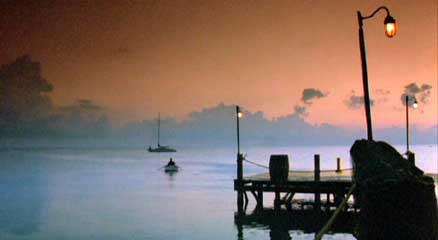 |
|
Eureka should have been a brilliant movie, but wasn't. Instead of a disjointed three act play, it could have been a focused story about the life of the Oates family in the Bahamas, and their inability to make it work despite infinite riches. The surreal portion in the Klondike, trimmed of some dialogue, would have made a beautiful prologue to that. Ultimately,
it should have been Harry's story, and it should
have ended with Harry's death, sculpting a sad
commentary on a man who achieved everything he had
dreamt of for the first forty years of his life, and
then could never find a way to enjoy it, because the
process of achieving his dream changed the man who
dreamt it in the first place. And the director
should have let us see that point for ourselves
inside of the story, instead of having the
characters deliver soliloquies about it. ===== Post
scripts: |
|
